

Recently, I had a long meditation and conversation with a friend, mentor, and former investor, who happened to be truly a one of a kind human being & simultaneously a very successful person - a founder of a unicorn/investor of a bunch of them🦄
Right here on this spot. Can you guess where it is (answer below)?
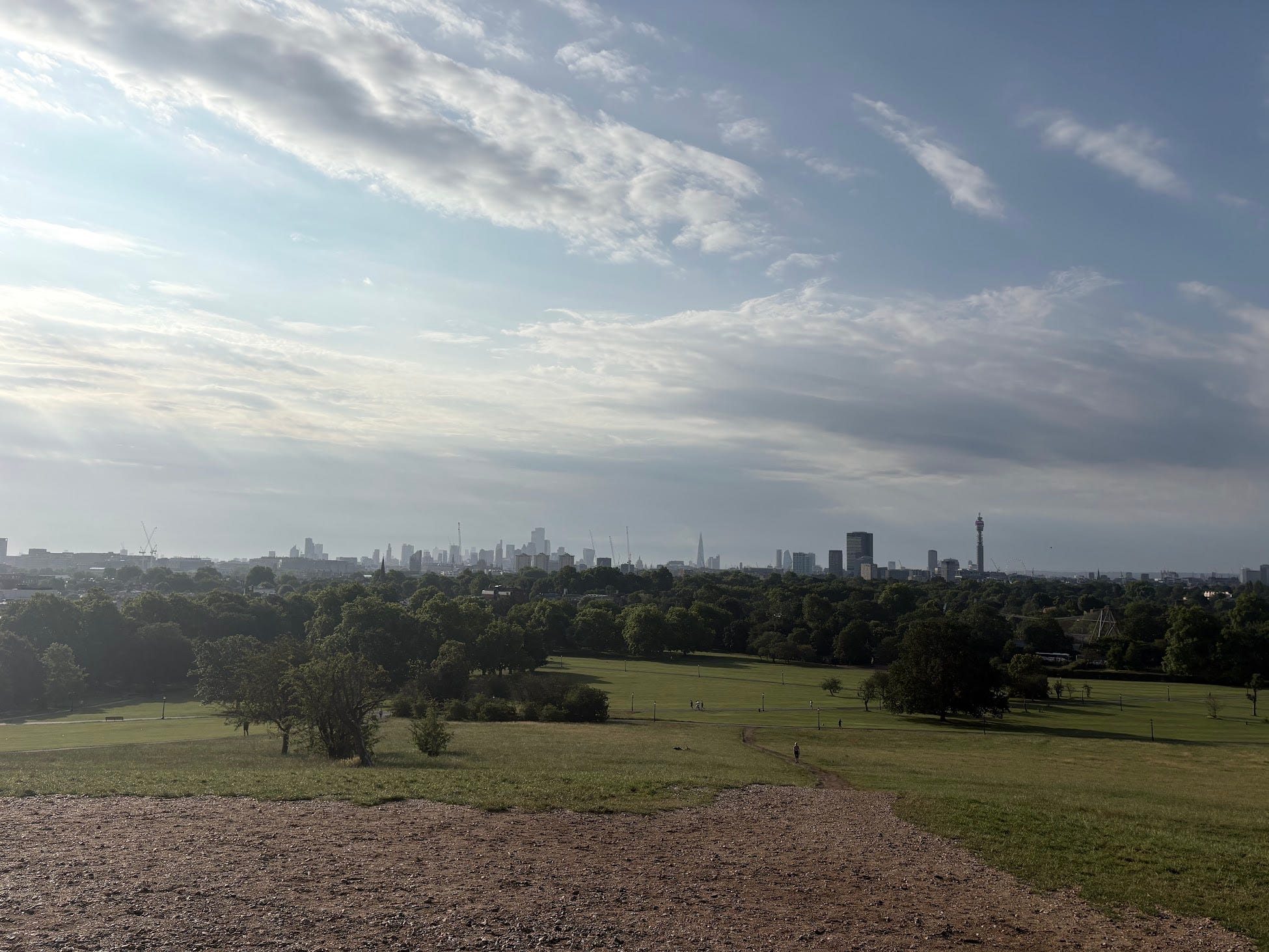
It’s Primrose Hill in London. Fun fact - it is considered the birthplace of the modern Welsh Druidic tradition.
On the summer solstice of 1792, poet Iolo Morganwg gathered Welsh bards there for the first Gorsedd ceremony. They formed a stone circle and performed rituals in the open air while the sun was above the horizon. It wasn’t an uninterrupted ancient tradition -Morganwg largely reinvented it - but the movement became culturally significant and survives in Wales today. So Primrose Hill’s spiritual association isn’t merely vague “energy”: it was deliberately chosen as a meeting point between earth, open sky, sunlight, poetry and collective intention.
Anyways; somehow (as things are in life) we got into a very fundamental question:
Given who I am, what I am naturally good at, and what is about to happen in the world - where should I put my energy?
I think that many entrepreneurs (if not most of them!) are quietly asking some version of this question right now.
The world is changing extremely quickly. Almost too fast. AI is rethinking what can be built, how companies are created, how people work, and what a small group of people can accomplish. Clearly there is no shortage of opportunities.
It is becoming harder to understand what to do, what to ignore, and what deserves years of your life.
The conversation gave me a framework for thinking about this, and I thought it’s worth sharing it all with you to start a discussion 🫶🏻
(note - this framework is 100% authentic conversation; and the quotes/pictures were generated by me specifically to convey the right feeling)
1. What kind of fish are you?
Every person has some kind of light.
By light, what’s meant is not a profession, a title, or one particular type of business. Nor some weird spiritual shit. Rather a way of manifesting yourself in the world.
The final form can change. It can be a company, a fund, a community, media, a product, a movement, or a network of agents. But the internal way a person acts may remain largely the same.
The first part of the framework is understanding what kind of fish you are.
There are three questions:
What do you genuinely enjoy doing?
What are you good at?
What do people consistently praise you for, return to you for, or describe as your strength?
The point is not to copy somebody else’s archetype. It is to understand your own.
If you are a fish, it makes little sense to spend your life trying to become a squirrel simply because squirrels happen to be fashionable right now.
This sounds obvious, but entrepreneurs do it constantly. We see a form that is working for someone else and assume that the form itself is the answer.
But the form is secondary.
The more important question is whether it allows your natural way of acting to fully express itself.
2. The pre-wave

The second part of the framework is the pre-wave.
We like to believe that we create waves. The ego wants to think: I invented it, I built it, I won.
But reality is more subtle.
A wave is already emerging from technology, culture, capital, human pain, and new forms of behaviour. The entrepreneur does not create the ocean. The entrepreneur notices the wave, gets into the right position, and applies their own way of acting to it.
The wave also has to be at the right stage. It should still be rising. If it has already started breaking down, it can simply wash you away.
This creates two questions:
What pre-wave is already rising, but has not yet become obvious to most people?
And:
Which part of that pre-wave matches my nature?
An opportunity may be objectively large and still be wrong for a particular person. Another opportunity may look less obvious, but match their nature, experience, relationships, and way of operating much more closely.
The goal is not just to find a growing wave.
It is to find the part of the wave where your way of acting is not an accessory, but a key part of why you may succeed.
3. AI as a historical moment
The most obvious rising wave today is AI.
Our joint hypothesis is that the next 1.5 to 2 years may radically change business, work, company creation, capital, education, media, and human agency.
One reason is the acceleration of recursive self-improvement.
Models are beginning to help improve models, tools, code, research, experiments, and processes. Each improvement can make the next improvement easier or faster.
Human intuition is not very good at understanding this kind of speed. We are more comfortable with linear progress than with loops that accelerate themselves.
This does not mean that every AI company will matter, or that simply adding AI to something is a strategy.
It means that the surrounding world may change much faster than most of our plans assume.
So the question should not only be:
What do I want to build?
It should also be:
What new world is already appearing, and where is my natural leverage inside it?
AI is the historical context. It is not the complete answer.
The answer still has to come from the intersection between the external wave and the internal way a person operates.
4. Not every decision needs to be made immediately
Another part of the conversation was that not every decision has to be made immediately.
Sometimes the correct mode is integration.
An athlete does not have to compete today if they are training to reach the right form in three months. In the same way, a person can honestly say:
“I am currently going through a period of assembly. I will make the decision later, from a stronger state.”
The important distinction is between integration and procrastination.
It is not procrastination if there is a process.
It is procrastination if there is no process.
A process means that something is actively being assembled. You are observing, thinking, testing, meditating, speaking with people, or exploring different directions. You may not have made the final decision, but you are moving towards a state from which the decision can be made more clearly.
Without a process, postponing the decision is simply avoidance.
This matters because the speed of the external world can create artificial pressure to make an immediate commitment. But moving quickly in the wrong direction is not necessarily better than taking time to reach a more honest decision.
So; what’s the working formula?
I started with the question:
What idea should I choose?
I now think the better question is:
What pre-wave is rising right now, where my way of acting is not decoration, but the key?
That question contains both sides.
The external side:
What is changing in technology, culture, capital, behaviour, and human needs?
And the internal side:
What do I enjoy? What am I good at? What do people return to me for? What is my accumulated context? Where does my intention flow naturally, and where do I block it?
The answer is unlikely to come from choosing the most fashionable idea.
It is more likely to emerge from the intersection:
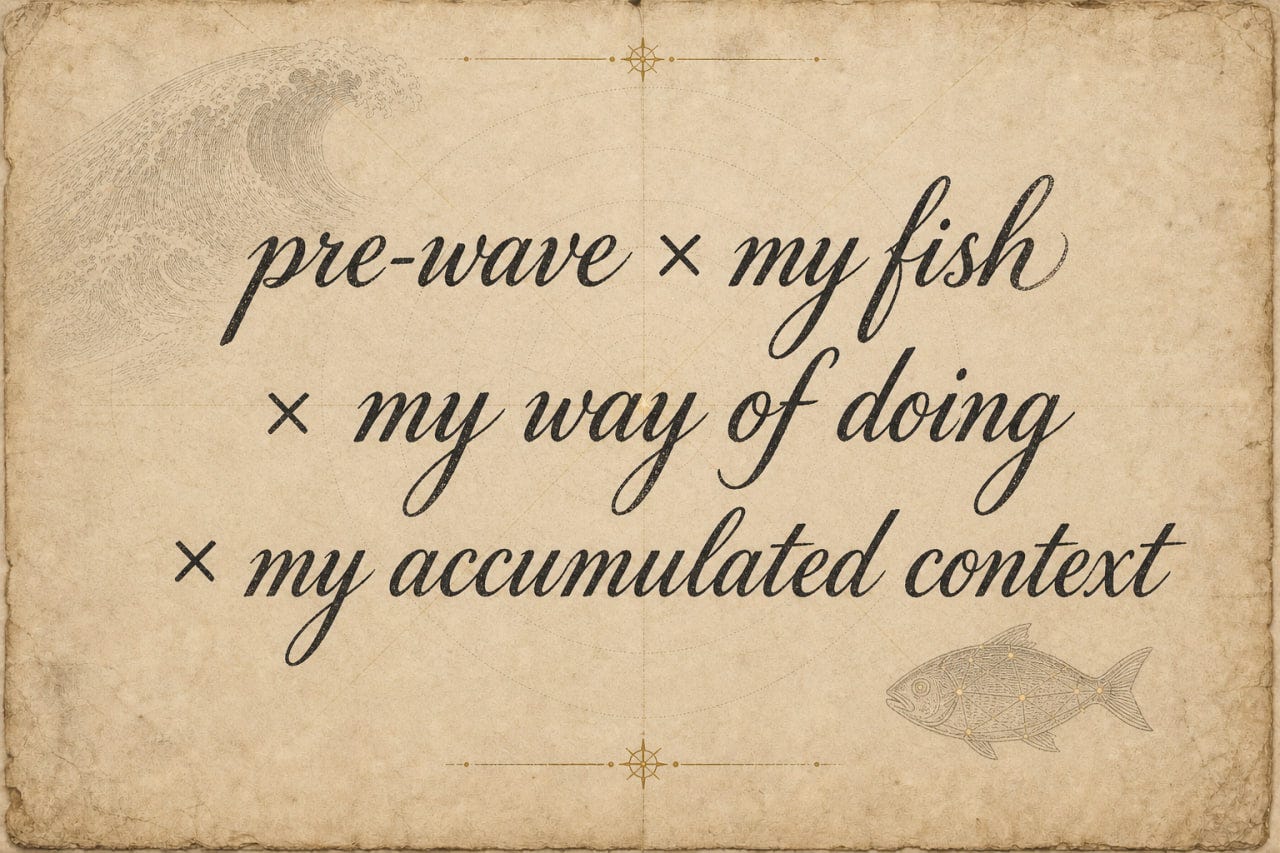
pre-wave × my fish × my way of doing × my accumulated context
That is the framework I am currently using to think about what I should actually be doing right now.